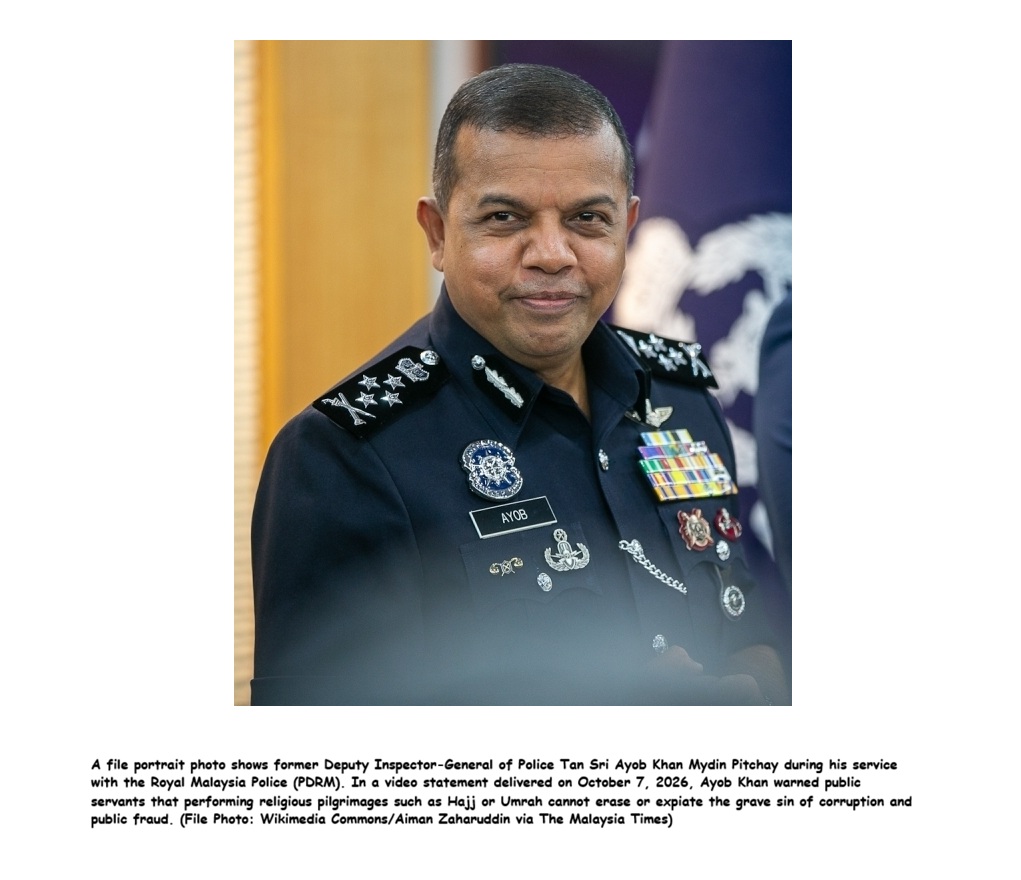
‘Performing Hajj or Umrah will not erase the sin of corruption’: Former Deputy IGP Ayob Khan warns public officials against false spiritual comfort
KUALA LUMPUR, Oct 18 — Former Deputy Inspector-General of Police (DIGP) Tan Sri Ayob Khan Mydin Pitchay has warned civil servants and public officials against harboring the misconception that taking part in religious pilgrimages can expiate or erase the sins of graft and corruption.
In a video statement dated October 7, 2026, and widely reshared on social media today, Ayob Khan addressed common rationalizations used by corrupt individuals who believe performing the Hajj or Umrah will absolve their illegal financial gains.
“There are people who hold the opinion that taking bribes is commonplace, assuming that going for Hajj or Umrah will make everything alright,” Ayob Khan said in the recorded speech. “They believe that by performing Hajj every year or Umrah every week with illicit money, the sin of corruption will be wiped clean. That is completely untrue.”

Distinction between personal sins and public corruption
Elaborating on Islamic jurisprudence, the veteran former senior police officer explained that while personal sins committed directly against God can be forgiven through sincere repentance (taubat nasuha), corruption constitutes a violation against the entire public.
Citing classical Islamic scholar Ibn Taymiyyah’s Majmu’ al-Fatwa, Ayob Khan emphasized that graft involves usurping public resources and the rights of millions of citizens, making absolution virtually impossible without full restitution.
“If you commit personal sins like drinking alcohol or gambling, God is Most Forgiving if you repent,” Ayob Khan clarified. “But corruption is a sin against the entire public. If you take hundreds of millions in bribes over decades and enrich your family, how can you possibly ask forgiveness from every single citizen you defrauded?”
Comparison to prohibited substances
Ayob Khan drew a stark comparison between corruption and forbidden items, stressing that while emergency circumstances (darurat) may temporarily permit certain prohibitions, corruption remains strictly unlawful without exception under any circumstance.
“In a dire emergency, consuming prohibited food like pork may be permitted to save a life, as scholars explain,” he stated. “However, corruption is never permissible under any circumstances whatsoever. That is the fundamental difference.”
He urged officials and community members to hold firmly to ethical values and refrain from misusing religious obligations as a shield or justification for systemic financial misconduct.
— The Malaysia Times

